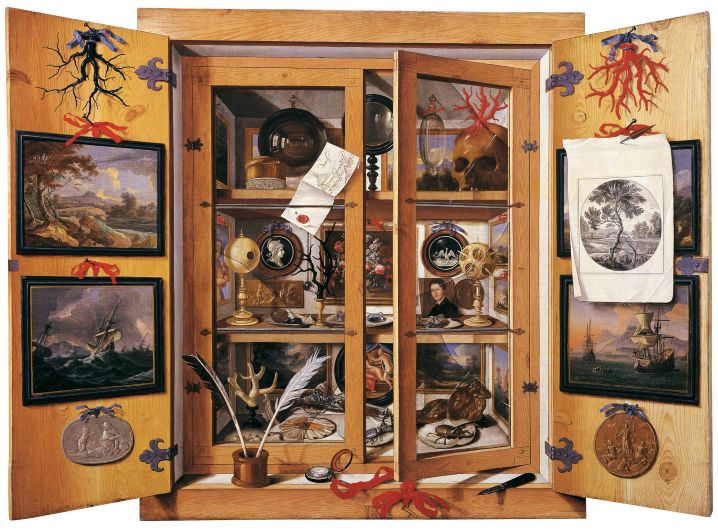
Open the doors. Peer inside. There are strange plants and specimens. Skulls and bones, corals and stuffed birds, globes and drawings and maps. The Victorians loved to collect like little dragons with their hoards of scientific samples from all over the world. They were obsessed with ferns, stuffed birds (and other animals), and entombed exotic flowers under glass. As such, the Victorians created cabinets of curiosities to display these treasures, and it is that concept we took when it came to designing the world of The Last Garden Party. Ever have a garden party in a Victorian conservatory before? Take our hand, and we’ll guide you through the scenic design behind our latest Master Mystery Production. Just mind your fingers. We hear some of the plant specimens may have teeth…
CABINET OF CURIOSITIES: The Making of The Last Garden Party (Part 3)
The Victorian era in England did see huge advancements in science and industry as interest in the natural world blossomed. After all, Charles Darwin wrote The Origin of Species during this era. Yet, while they loved all the strange and exotic new species and specimens from around the world, wealthy Victorians didn’t like…you know…actually being in nature. Fresh air, sunshine, dirt. Keep it far away from them. They liked their wildlife cooked or stuffed on display. Ferns and flora were shielded under glass domes and terrariums. And butterflies were pinned. Nature, to the Victorian mind, had to be studied and controlled. It wasn’t about appreciation or protection. It was about mastery. Hence why a lot of women wore half a stuffed pheasant on their heads.
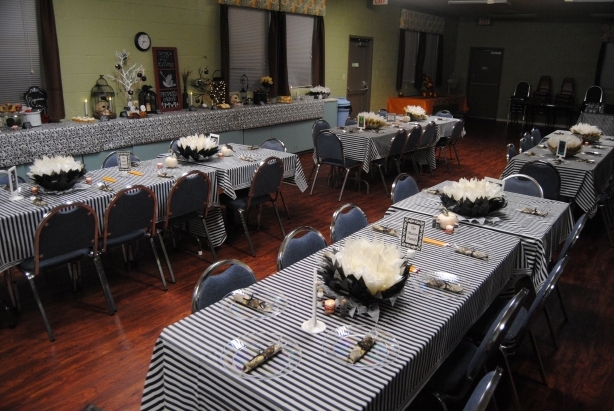
Our venue for the show is the Fellowship Hall at Ridgecrest Presbyterian Church, which has hosted a number of our Ridge Writers’ Weird Weekend shows over the past decade such as Pauper’s Grave, What Happens at Sundown, and Close Encounters of the Hairy Kind alongside standalone works like Ode to Agatha. Of course, one thing becomes clear to you–It’s an interior room. For a play set in a garden party. Presents a few complications for the suspension of disbelief, doesn’t it? Luckily, theatre is a magical space where stylization, abstraction, and illusion are part and parcel with the whole experience. No one said we had to have a literal garden this time around…
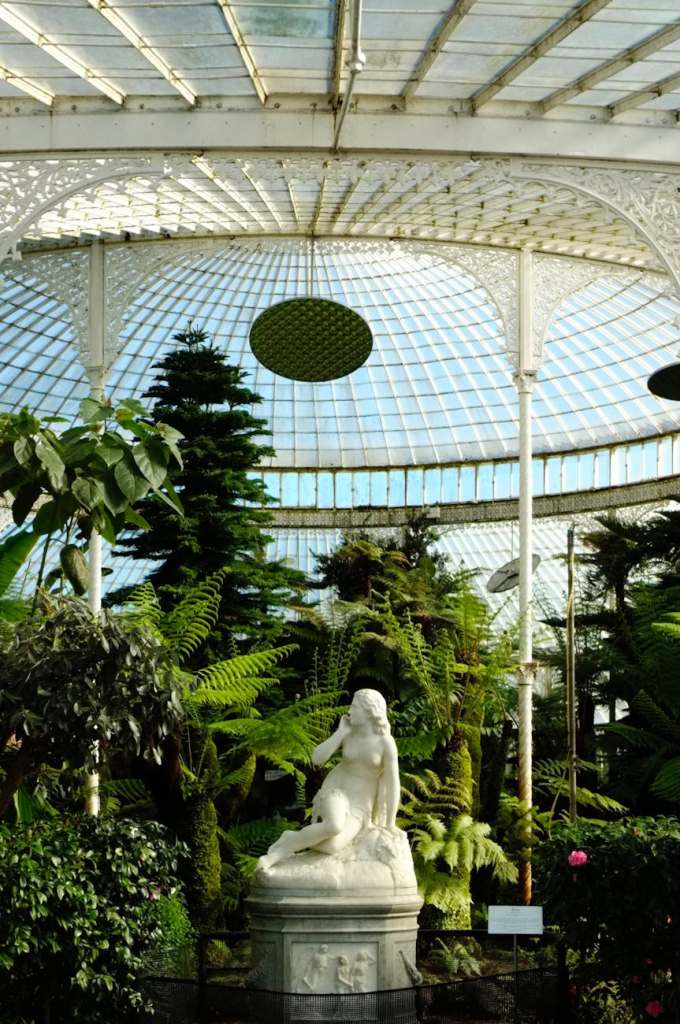
Which leads us to the concept of a Victorian conservatory or solarium. Fancy sun room, if you prefer. These conservatories were like greenhouses filled with delicate plants from faraway places. Perhaps ferns (Victorians were OBSESSED with ferns) or other exotic flora to display the reach of the British Empire. These glass houses–careful with your stones–had places to sit, had tea tables servants could wheel in, and provided a place in the infrequent English sunshine for the wealthy to unwind without all of that awful…you know…nature.
We jest (kinda), but with this interior room willed with windows on both sides (exterior AND interior walls), it gave us a chance to turn our set for The Last Garden Party into a “garden under glass.” Emphasize the artificiality of Victorian approach to the natural world. Terrariums, birdcages, pinned butterflies, botanical prints, decorative stained glass…these formed the centerpieces of our concept for the production.
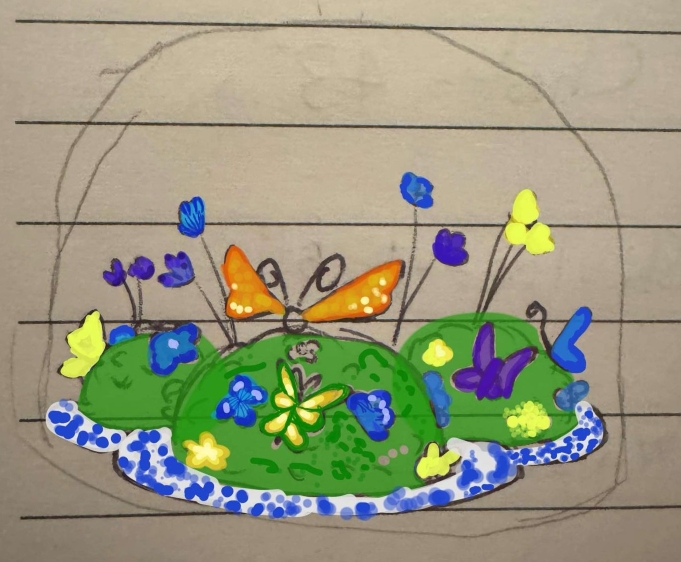
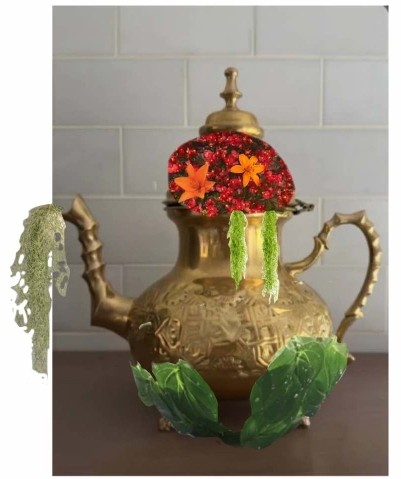
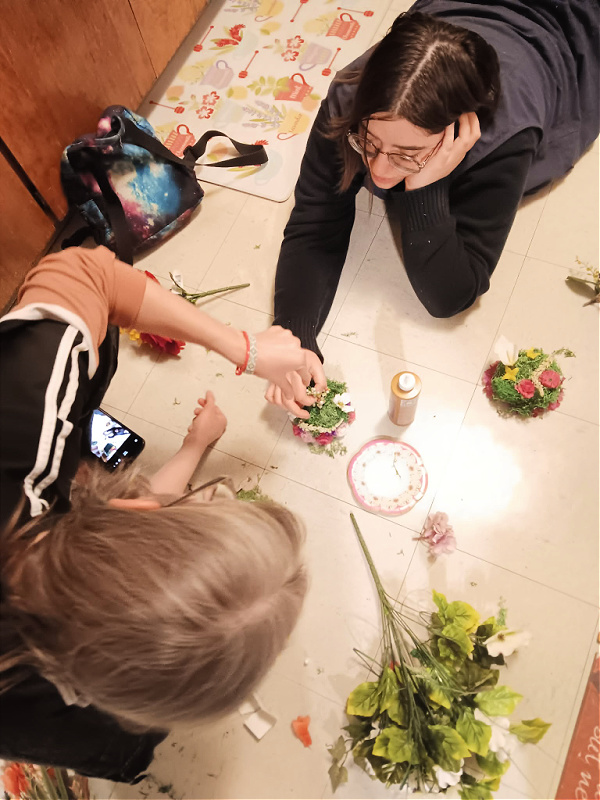
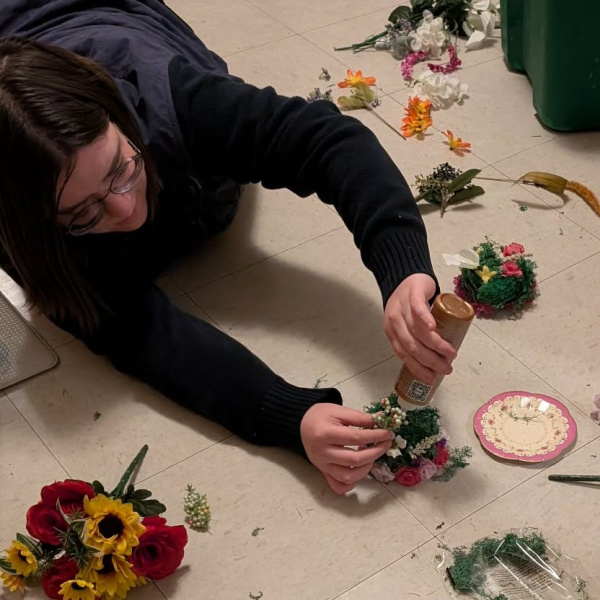
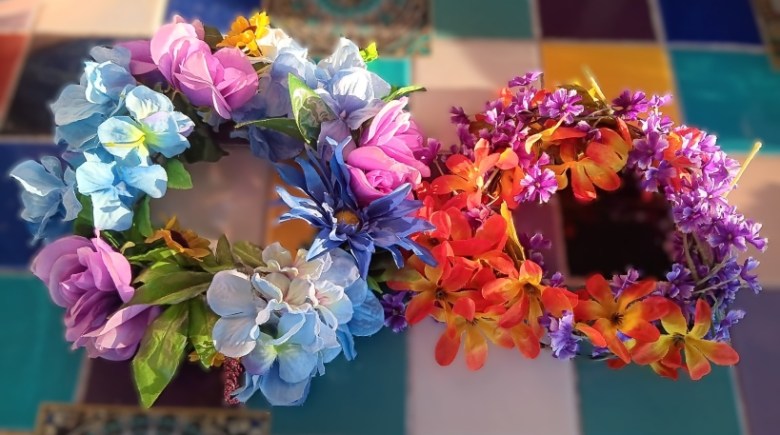
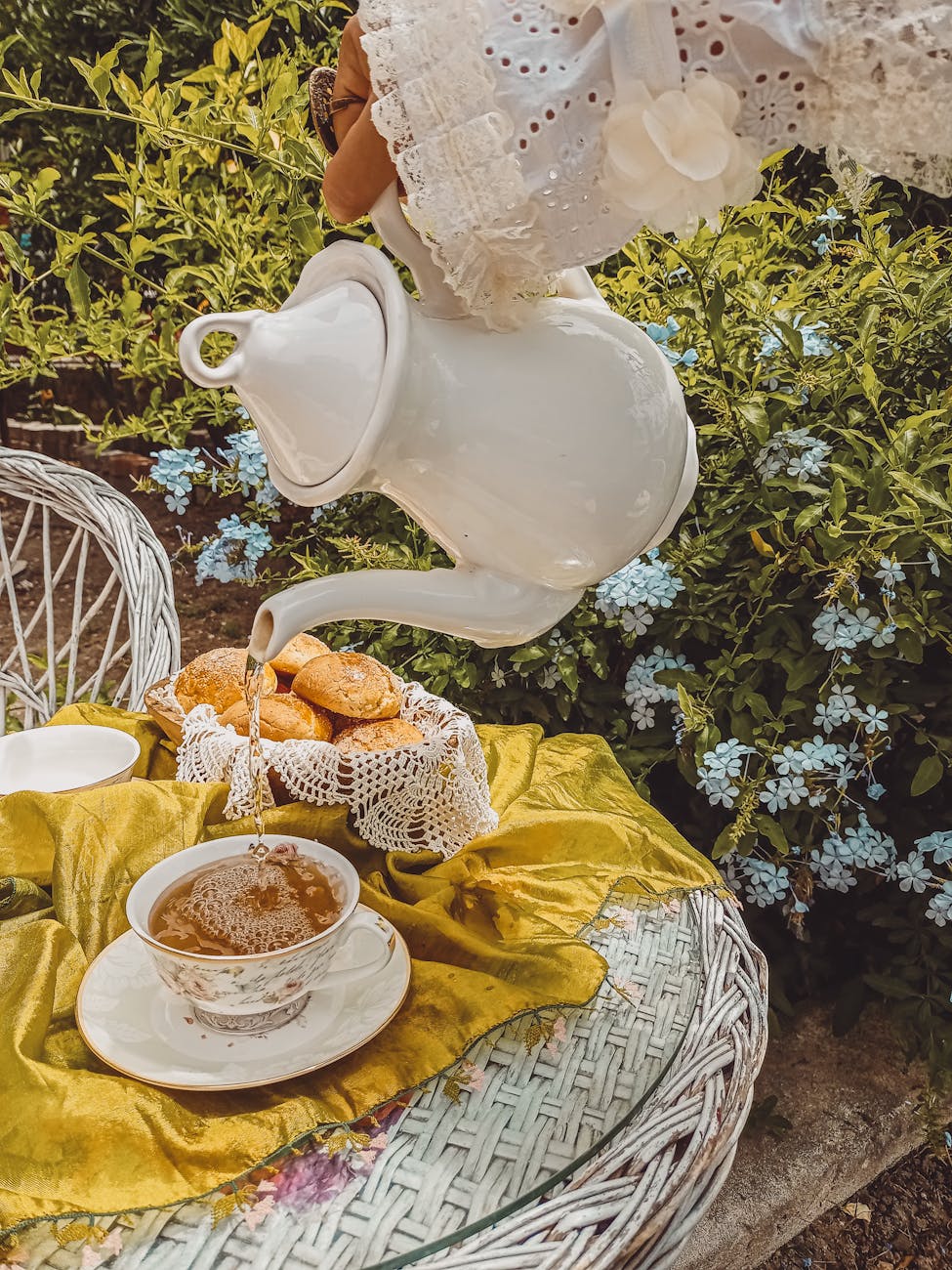
Speaking of centerpieces, with the amount of tables in the room for guests to enjoy their tea, we needed compact and story-enriched centerpieces to enhance the mood and carry the design across the space. Murolo Patchin designed the centerpieces as one of the Prop Masters while Janis Kunz, with the help of the whole cast, helped him execute his ideas. We have three styles of centerpiece: flora under a glass dome, teapots spilling with flowers, and floral candle rings. Guests will be served their treats family-style to allow the actors their time to shine without the fuss of service distracting the audience. There are two service periods during the show: pre-show and intermission. Beth Sparks-Jacques, who has recently catered Ridge Writers’ phenomenal Dickens Teas the past couple years, donated the china service for the audience to use.
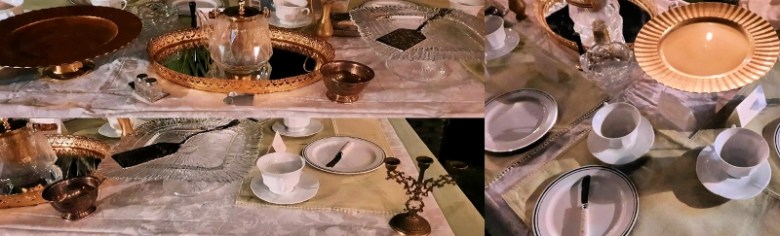
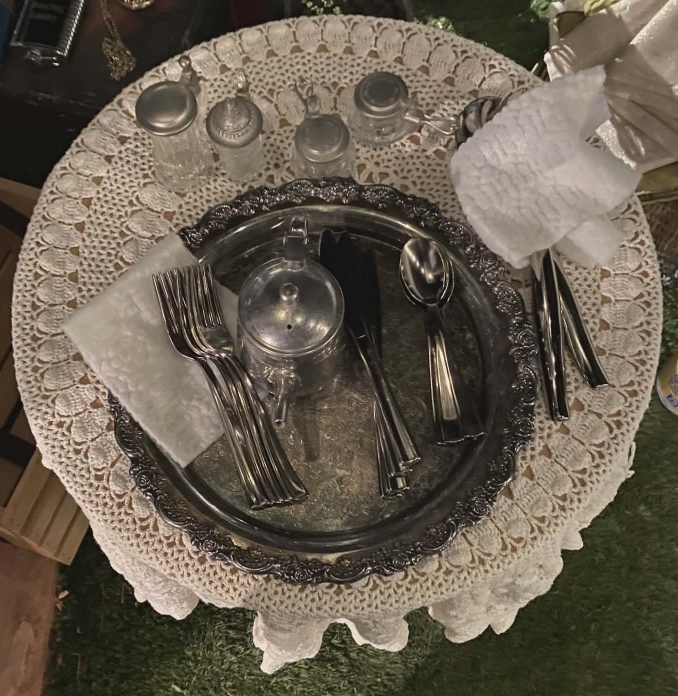
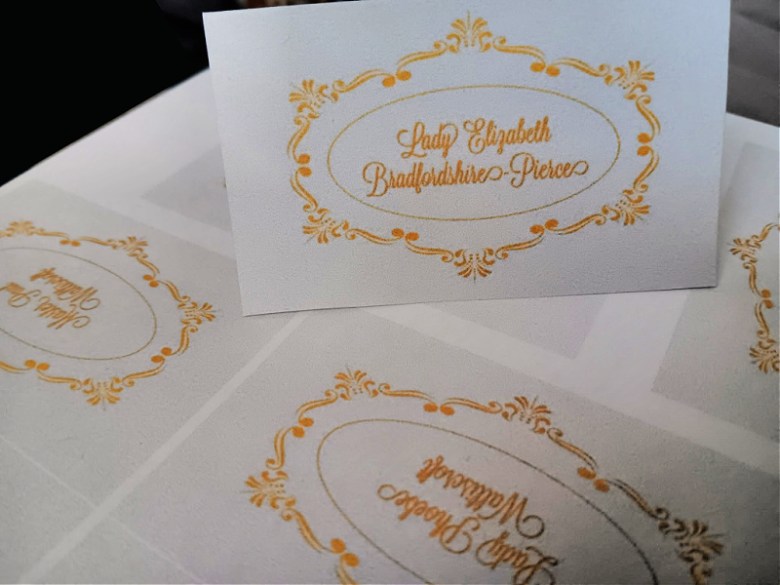
But while our guests enjoy their tea, we couldn’t leave out the actors. Their tea service is a sea of crystal, china, brass, and sterling. Set Designer Daniel Stallings had a faceted glass teapot–not unlike a lauded diamond, perhaps–saved for the revival intended for the 2020 season. This teapot, with its crystalline body and brass accents, served as a jumping off point for the aristocrat tea service as a whole. The table service is a study of contrasts. Icy crystal, mirror, and sterling silver contrasts the warm brass and gold touches such as the writing on the placecards, which symbolizes the hot-headed passions that can brew beneath cool Victorian etiquette and demeanor. The key to mixing finishes is repetition. The crystal teapot is picked up in a cut crystal cake plate and a crystal sugar bowl. The brass accents on the teapot are echoed in the bradd milk jug, the golden cake plate, and the brass bell for summoning servants. The sterling silver is repeated in the mirrored tray, the edging on the plates, the butter dish and butter knives, and so on. The servants, meanwhile, have a wooden table with a humble crocheted cloth and a pile of silver to polish. It may not be the most historically accurate setting with every finish matching precisely, but there’s a charming Alice in Wonderland eccentricity to it that gives it character and style, far more important for a farcical play such as The Last Garden Party. Set dressing should have personality. Ruby Hand Award-winning Set Dresser Elise Bechtel conceptualized the aristocrat table while K. Pearl Woolam handled the servant’s table.
But it may be our backdrop that is the centerpiece of all centerpieces as we designed the largest backdrop in MMP history…
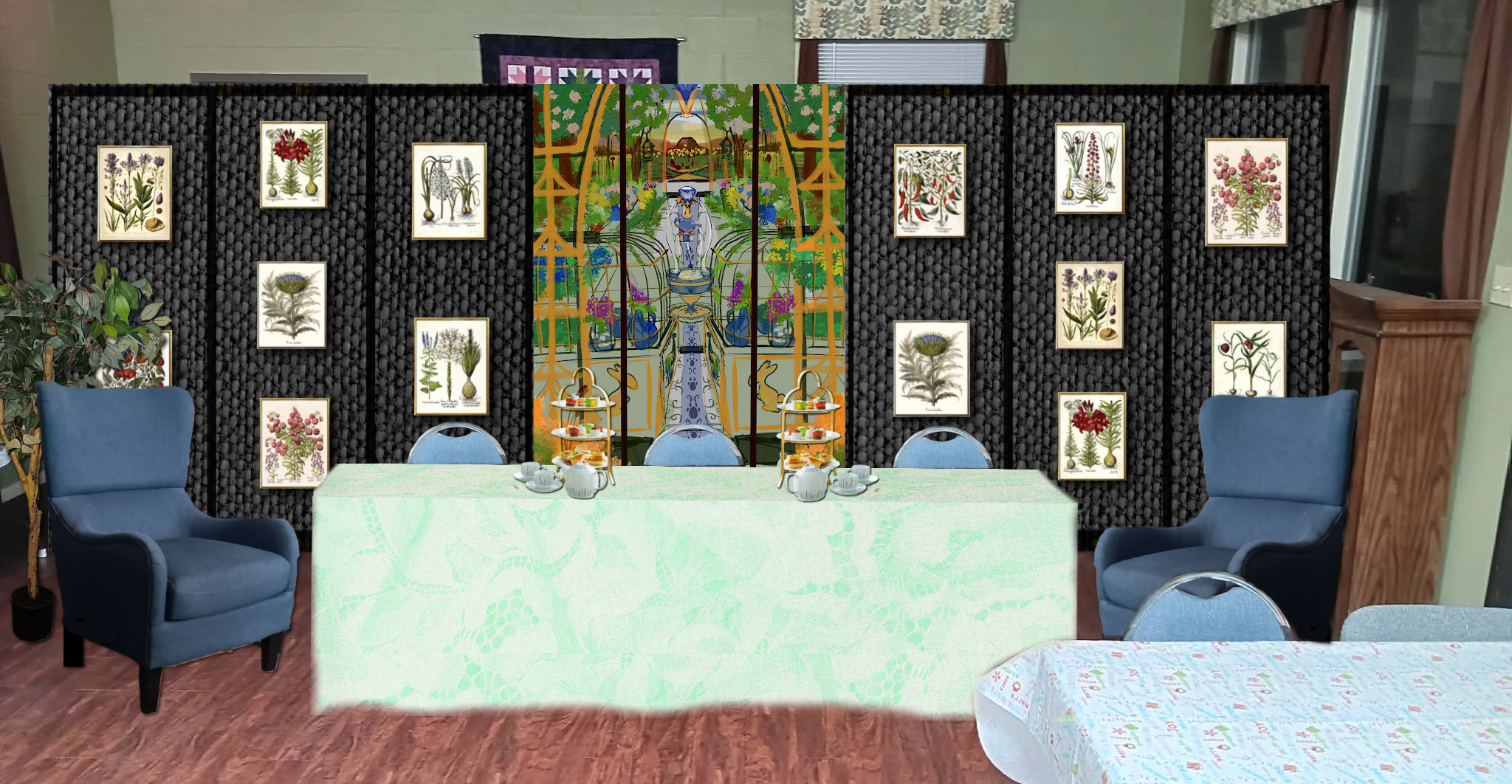
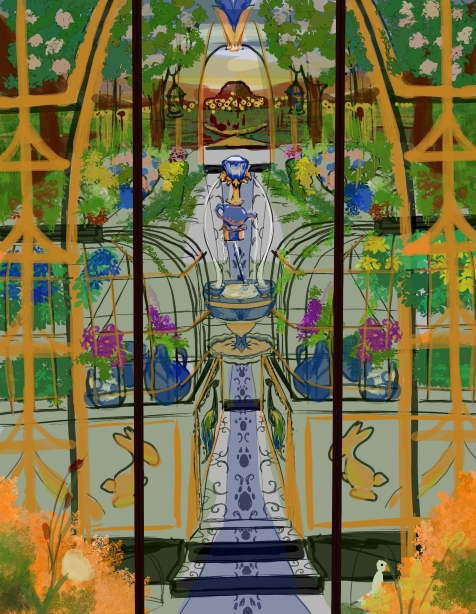
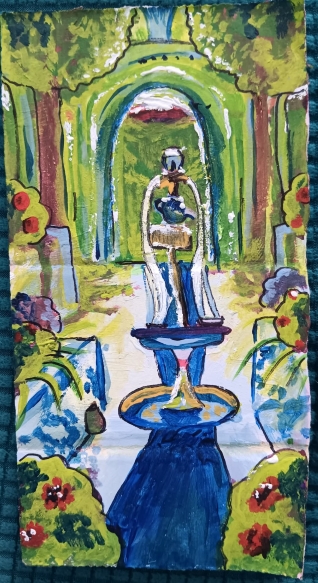
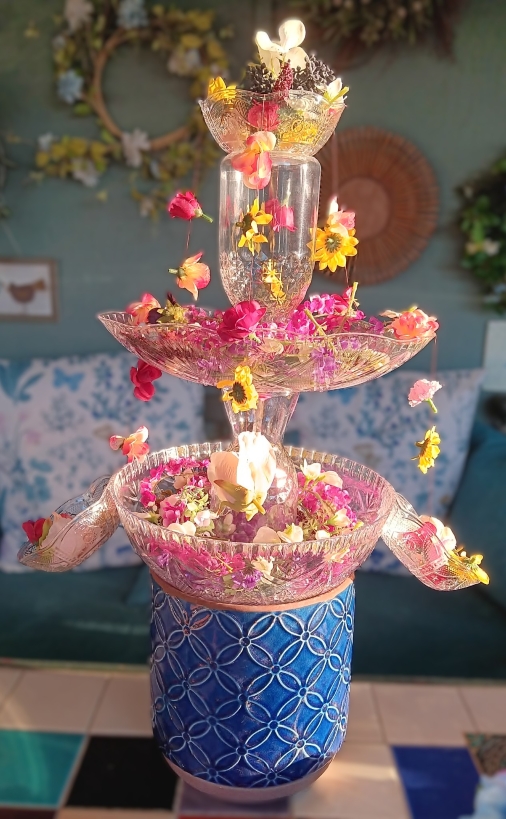
Reflecting the concept that our interior venue was turning into a Victorian conservatory or solarium, the focal point of the set’s backdrop was a “stained glass window” depicting a garden view with a cheeky burbling fountain. This initial concept was inspired by a real stained glass window at the Metropolitan Museum of Art in NYC: 3-part garden landscape window for Linden Hall, designed by Agnes F. Northrop and manufactured by Tiffany Studios. The central panel specifically, where the garden view recedes toward the horizon with a central fountain as an anchor for the whole view, was our primary muse. It allowed us to create a focal point for the set that suggests wide, open grounds and a false horizon, adding depth to the backdrop. It also adds to the “wall of windows” idea of a solarium. Bordered by woven screens, donated by friend of theatre Randi Fisher, which we will decorate with botanical prints, the effect of the primary set will be that of aristocrats taking tea surrounded by lush flowers. But these flowers are rendered artificially in paint and glass, highlighting the themes of duplicity and artifice present in the script. Nothing is what it appears to be. The stained glass panel is echoed in a similar stained glass window and a faux crystal fountain as the centerpiece of the set dressing on the long raised counter in the Fellowship Hall, creating balance in the scenic elements.
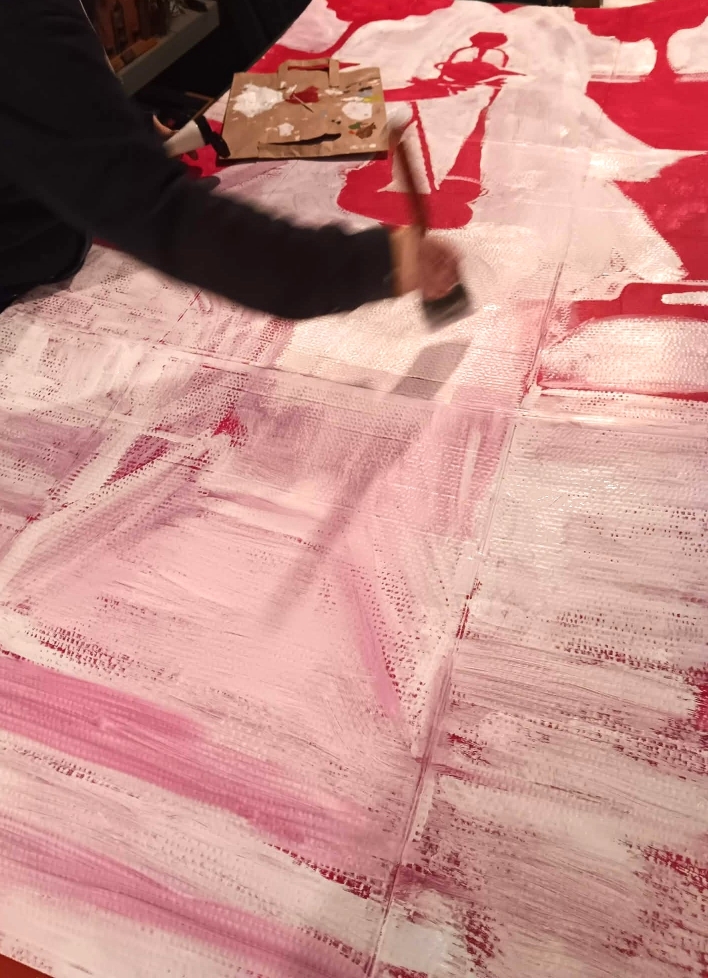
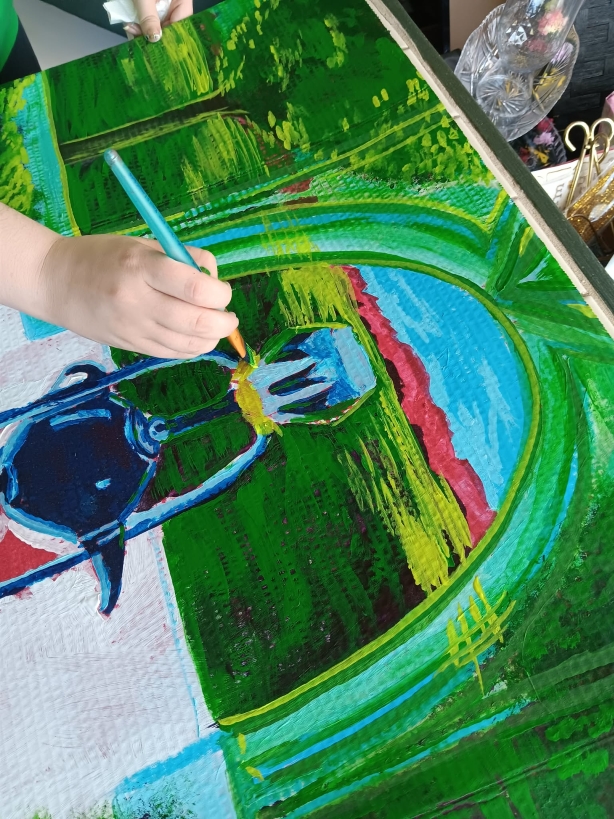
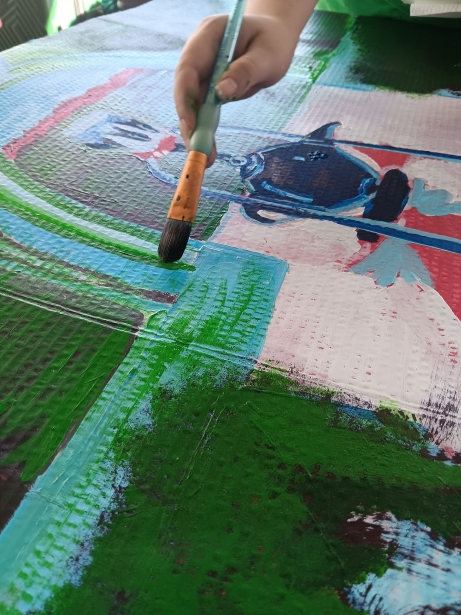
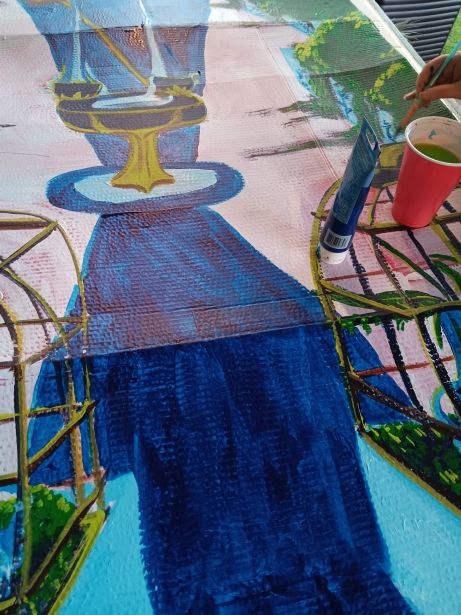
The stained glass panel is a painted work co-designed by director Devanne Fredette and assistant director Murolo Patchin, both talented visual artists. The panel is tri-fold to resemble a bay window. Devanne planned the paint scheme to mimic light bleeding through colored glass with red underpainting. Then color is gradually added in layers to fill the entire panel. The design of the fountain contains little Easter eggs to the story about to unfold: a teapot, a croquet mallet, a diamond. Could those rabbits be an homage to Devanne’s directorial debut, Malice in Wonderland?
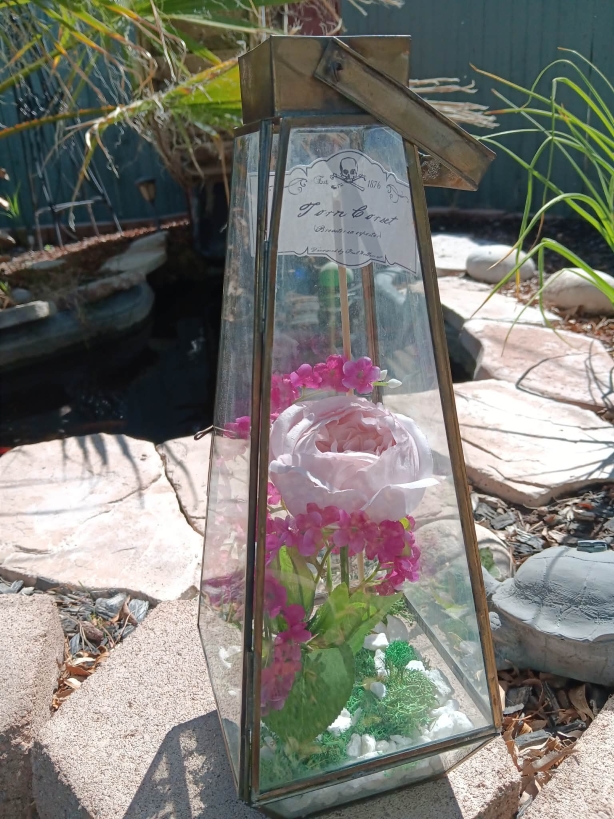
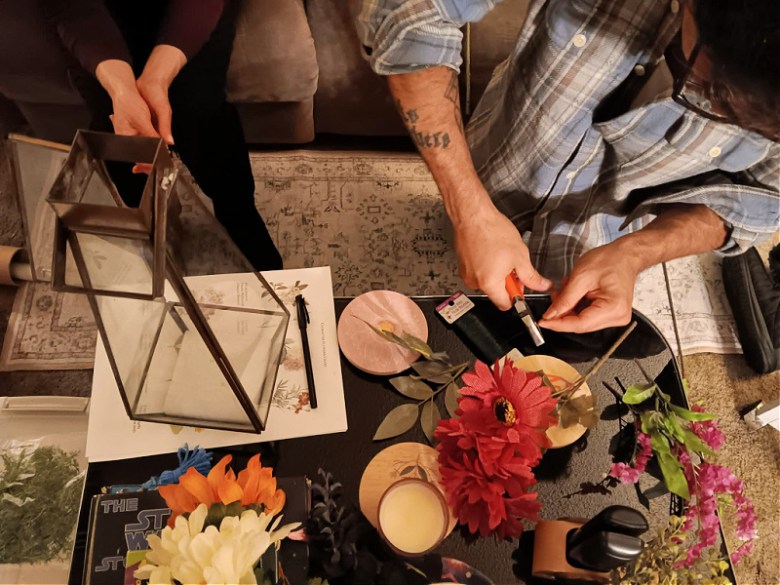
The Last Garden Party is as far from a serious drama as you can get. It’s a ridiculous comedy poking fun at the lunacies of Victoriana with chase sequences, wayward racoons, and tea-spiked whiskey. Our tongues are firmly planted in our cheeks. So there are moments of wit hidden through the set dressing. Like Paul’s specimens. The character of Paul Walliscroft is a burgeoning scientist and a studious scholar, a hoarder of knowledge who, no doubt, has his own cabinet of curiosities stuffed with intriguing shells, weird fossils, embalmed bugs, preserved plants, etc. So we said, “Why not make our conservatory Paul’s cabinet filled with his funny and weird specimens and artifacts and scientific paraphrenaila?”
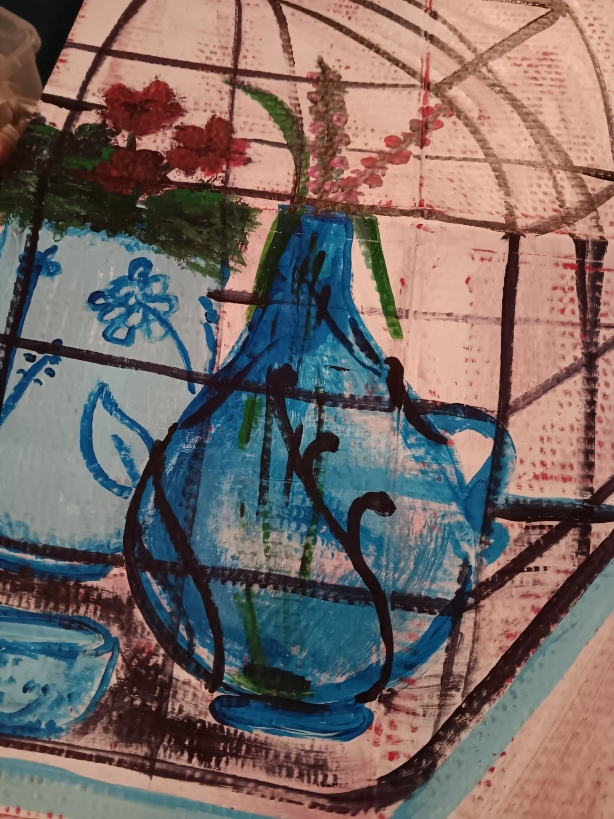
Actor Justin Small, who plays Paul, conceptualized all his specimens from their common names to their hysterical scientific names–such as Venetian Chamber Pot (Francorum stinkpoticus) or Guillotine’s Kiss (Headrollerus terribilis)–and then executed the plants in various vessels alongside his wife, Samantha Small, who plays Lady Elizabeth. Even the vessels have whimsy as Drunken Dubliner (Intoxicus gingeria) is stored in a clear, iridescent teapot. With labels identifying his exotic finds (including rather carnivorous flower), these flowers add humor to the scenery, keeping it from being too staid and formal.
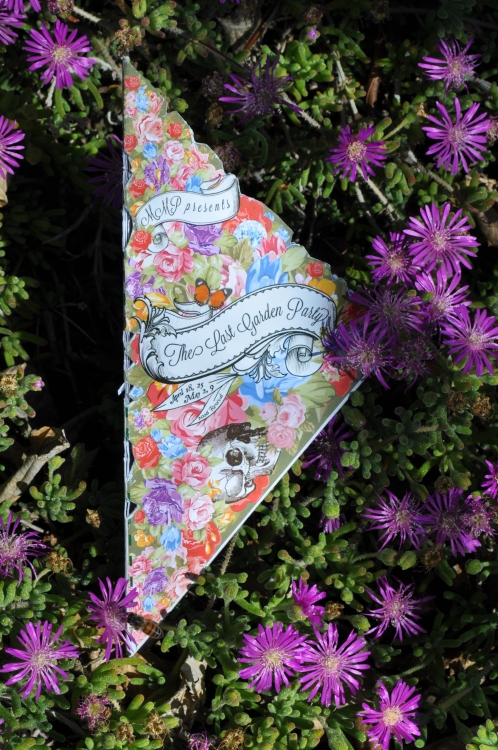
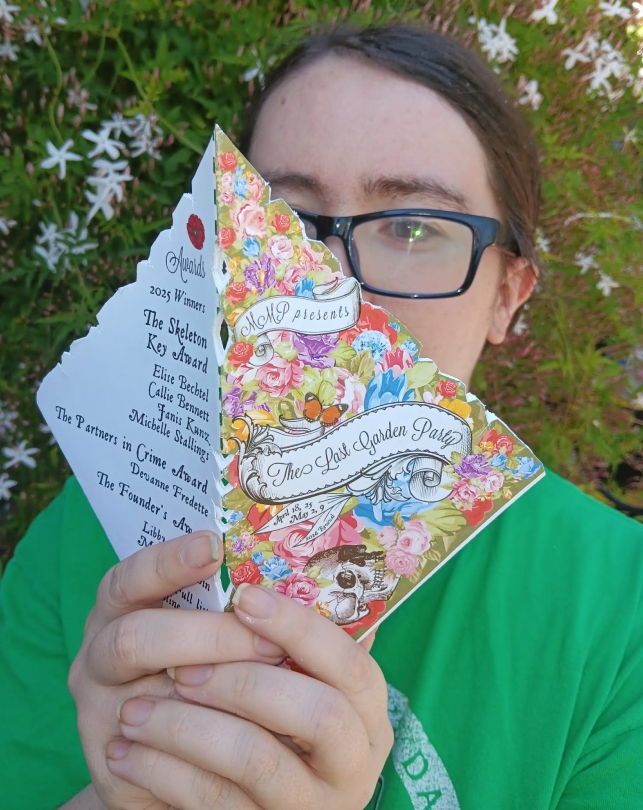
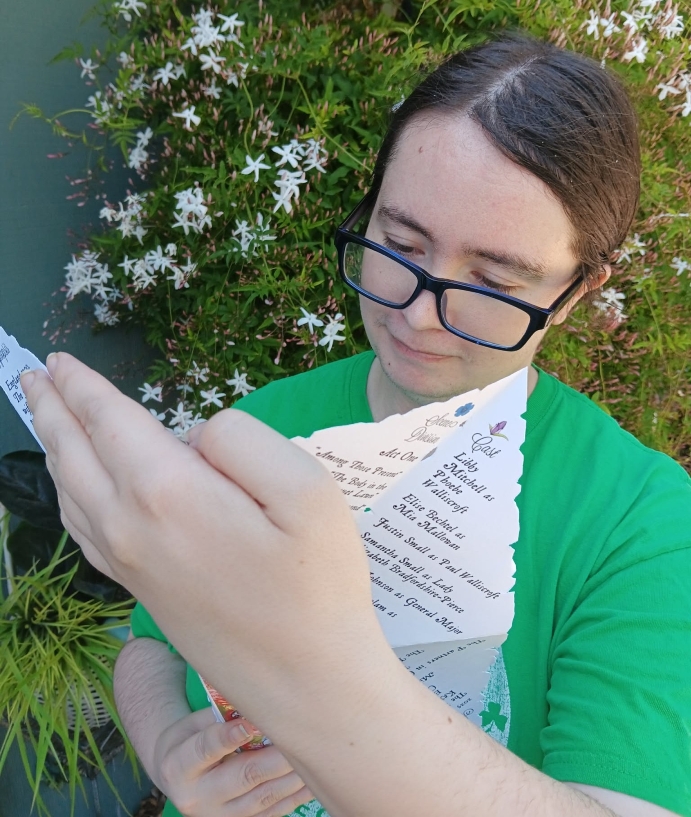
Even the programs add the charm of a Victorian superbloom. Inspired by a folding book, The Language of Flowers, we saw in the Victoria & Albert Museum’s collection, this insanely innovative design puts 16 pages on a single sheet of scrapbook cardstock. A little careful origami-like folding and precision cutting much like a paper doily or snowflake we’d make as kids in school turns this into the coolest MMP program in our decade-long history–maybe even topping the “rabbit hole” programs from Malice in Wonderland! Opening the program fully gives you this lacy, frilly placemat filled with information on the cast, crew, and show. It perfectly exemplifies the Victorian love of imaginative stationery and lace in a unique format that still fits in anyone’s program collection. Because what theatre nerd doesn’t save every program from every show they’ve seen or worked on? Just us? *nervous laugh*
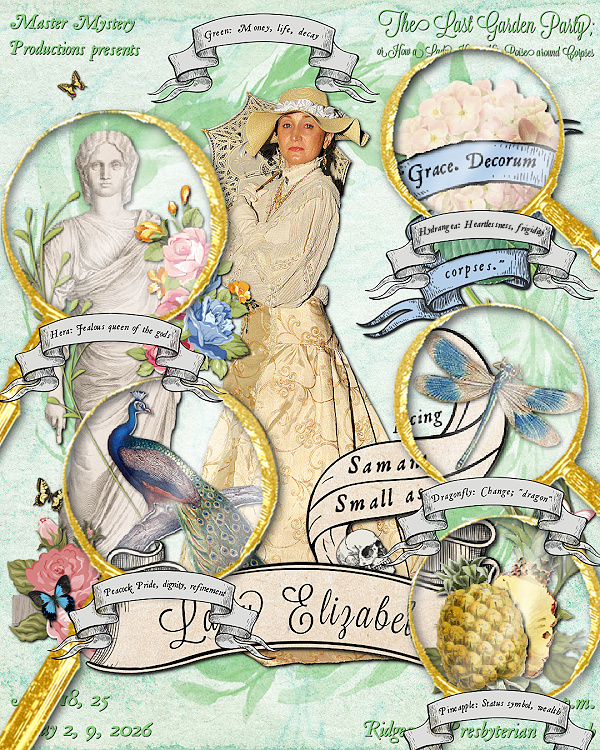
It’s the details that make the difference in a show’s technical design. Look closely at them. Not only for hidden jokes, but symbolism. During production, we assigned different characters their own color, flower, insect, bird, classical figure, and fruit inspired by the popular concept of floriography (the language of flowers) in the 19th century. What do these objects say about the characters? Well, you’ll have to do a little digging to find our secrets, but they are scattered throughout the show and its publicity. The character posters are designed to resemble Victorian cards, and we’ve secreted messages about the characters throughout. Keep your eyes peeled for all our hidden details!
It’s this embrace of Victorian maximalism and symbolism that adds delicious richness to the production and gives a Master Mystery Production its unique sparkle. Whether it’s who gets the biggest butter knife at the table or what kind of dog do the Walliscrofts have, we try to think of everything to make this a truly immersive show. Stepping over the threshold should feel like a kind of time travel. Take in all the details. We promise you there are tons of secrets to uncover.
But it’s not just the set design with hidden surprises and secrets. Every costume has a story to tell, some as far back as the original production in 2016. Breathing new life into a revival can mean giving original pieces a second chance, refurbishing and reimagining them for different actors, characters, or storylines. Stay tuned, because our next behind-the-scenes blog post will bring the spotlight to our gorgeous period costuming and how even ten-year-old pieces and characters can be refreshed with imagination in Second Chances: The Making of The Last Garden Party (Part 4).
Don’t forget your tickets. We’re expecting you for tea. You can buy your tickets here or in person at Red Rock Books. We’ll see you at the show!
–Master Mystery Productions
 Master Mystery Productions