
Every play for us begins with a concept. What universe do we find ourselves within? Is it a Jazz Age speakeasy? Wonderland? The Golden Age of Hollywood? Over the rainbow in the Land of Oz? A Gothic village? Under the sea? The possibilities are limitless. Think of these concepts as little pools of a multiverse–much like the Wood Between the Worlds–in C.S. Lewis’ The Magician’s Nephew. What happens when we return to a former pool to reexplore a universe? What new things will we learn? What will we want to share instead? Reviving a show is a lot like making a second voyage to a dream destination. We’ve been here before. We’ve seen the major sights. What else is there to uncover? The Last Garden Party‘s 2026 revival offers us a chance to return to Walliscroft estate…and there have been a few renovations since we last ventured over its grounds a decade ago. Playwright Daniel Stallings takes us through the script (and its new additions) in this behind-the-scenes blog post.
THE LANGUAGE OF FLOWERS: The Making of The Last Garden Party (Part 1)

The Last Garden Party blossomed from the Enchanted Garden space at Marcela’s, then known as My Enchanted Cottage and Tea Room, which was added to their venue to increase dining space and offer a variety of experiences. The show was designed to open the new space to guests for the first time. When I write a show for MMP, I think about the space it lives in. The cloistered atmosphere of the garden, with its high, latticed walls and white fence, reminded me of one of my favorite plays–Oscar Wilde’s The Importance of Being Earnest. I love his wit, his wordplay, his merciless takedown of Victorian custom and society…the list goes on. It became a fun challenge: How would Lady Bracknell, my favorite Wilde creation, fare in a Sherlock Holmes story?

It’s a funny mashup of two Victorian icons: the rapier, flippant wit of Oscar Wilde and the razor-sharp intellect of Sherlock Holmes stories by Sir Arthur Conan Doyle. I always like writing shows that contrast the previous show in the venue. Goodbye Hollywood, a cinematic drama about the traumas and trails of 1940’s Tinseltown, premiered at the tea shop the previous year, so I wanted the energy to change. Naturally, that means a comedy. My favorite comedies have dry humor, sarcasm, and wordplay in contrast to unhinged situations. It’s a formula used later on in Eat Cake, Who’s Who?, and Malice in Wonderland, but The Last Garden Party was the first true MMP comedy.

Humor comes from culture shock. Contrasting Victorian etiquette and culture–such as the immensely popular Mrs. Beeton and her Guide to Household Management or their fascination with the Spiritualism movement–with eccentric personalities who invent their own rules became the backbone of the show. It’s not just the Mrs. Beeton pronouncement that a hostess remain calm, cool, and collected during a party, but the Lady Elizabeth edict that a lady must always show grace, decorum, and poise around corpses. It’s the contrast of a young American woman among the stodgy English upper class. It’s the juxtaposition of a murder mystery and a classy tea party. Sure, why not have a seance to summon the spirit of the skeleton found in your croquet lawn? I mean, Queen Victoria was huge fan of spiritualism, and “one must never be too small-minded.”
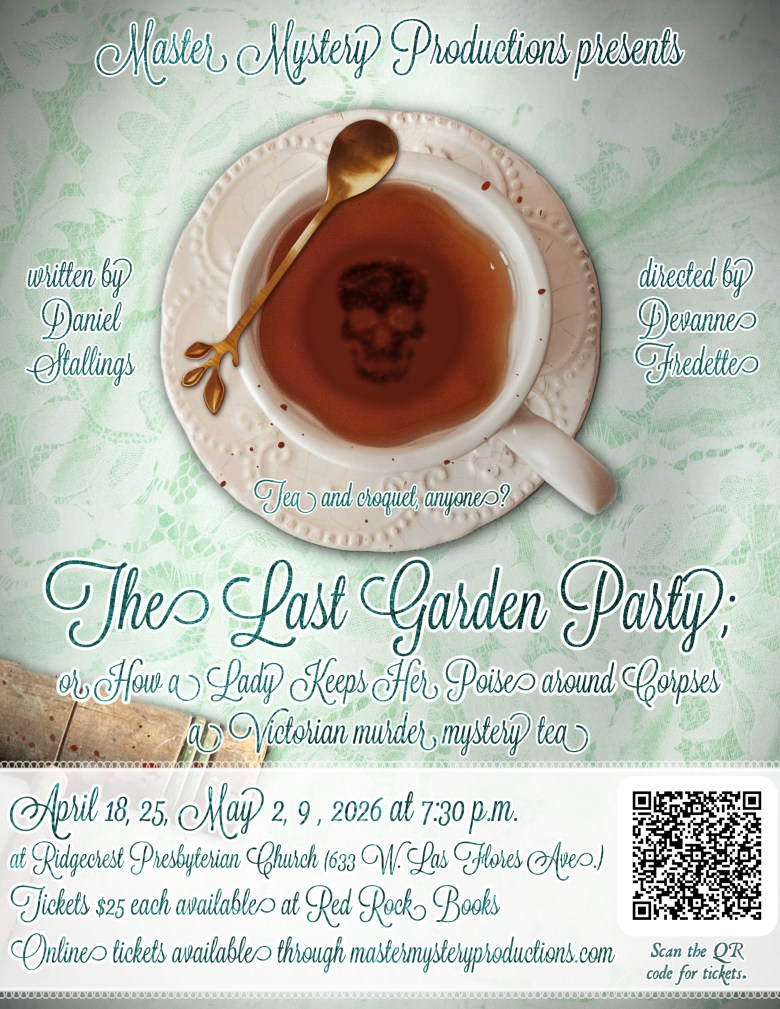
However, when it came time to revive a show, I wanted to do something we haven’t done yet at Master Mystery Productions: change the ending. Our mysteries are solvable; The clues add up to a satisfactory solution. So could I find a new solution for the same mystery? After all, those who saw the play ten years ago shouldn’t have an advantage in figuring it out. All’s fair in love and crime. I wanted to add new characters, scenes, jokes to make The Last Garden Party live a different life onstage. There are still silly seances and runaway raccoons for the die-hard fans, but also I changed up a few of the details to give the second half of the show an entirely new ending. Who is the body in the croquet lawn? Well, he’s not the same as he was a decade ago. But I’ll keep that secret for those who want to see the show.
When I wanted to add characters, I wondered who I was missing. The original show starred five aristocrats–a shy American second wife, a stiff, studious, scholarly stepson, a sassy ward, an imperious dragon of an aunt, and a drunked general who was some obscure relation. It came to me: the servants. I was missing the downstairs characters. Again, here is contrast for humor: upstairs vs. downstairs. So I wrote in a housekeeper, a parlourmaid, and an undergardener to add diversity among our cast. Not everyone has a posh RP accent. Even Rutherford, a pesky pooch mentioned in the original production, gets a little bit more love in the revival. And when I decided to title the show for the revival, I thought it would be funny to take inspiration from the bonkers extended subtitles in literature from earlier centuries such as the original title for Robinson Crusoe—The Life and Strange Surprizing Adventures of Robinson Crusoe, Of York, Mariner: Who lived Eight and Twenty Years, all alone in an un-inhabited Island on the Coast of America, near the Mouth of the Great River of Oroonoque; Having been cast on Shore by Shipwreck, wherein all the Men perished but himself. With An Account how he was at last as strangely deliver’d by Pyrates. Why have one title when you can have multiple? So I played with that and made a reference to Lady Elizabeth’s iconic line from the show.

One difficulty that arises in reworking any script is “what do I change? What do I take out?” I wanted the script to maintain the original vibe, but it needed novelty to allow those who had seen the first show have a reason to see it again. In the first pass of the revival script for the cancelled 2020 production, I actually removed the beloved seance scene out of concern that the show was too long and a desire to change up the passage of events. But, in reworking it for 2026, the director and I agreed that that scene, which was one of our absolute favorites in MMP history, should return to pay homage to the genius of the original production. So I added it back in. It didn’t make the show too long, and I am delighted to see this new cast bring it to life in hilarious ways.
In times of difficulty or after strenuous productions, it’s so healing to hear laughter again. Laughter rings out at rehearsals for The Last Garden Party night after night. The cast sparkles like a legendary diamond. I always love hearing actors perform, because they do so much to strengthen the words I wrote. A script is only half-finished once it’s written; It needs the voices to complete the picture. So thank you, the cast and crew of The Last Garden Party; or How a Lady Keeps Her Poise Around Corpses, for bringing laughter back.
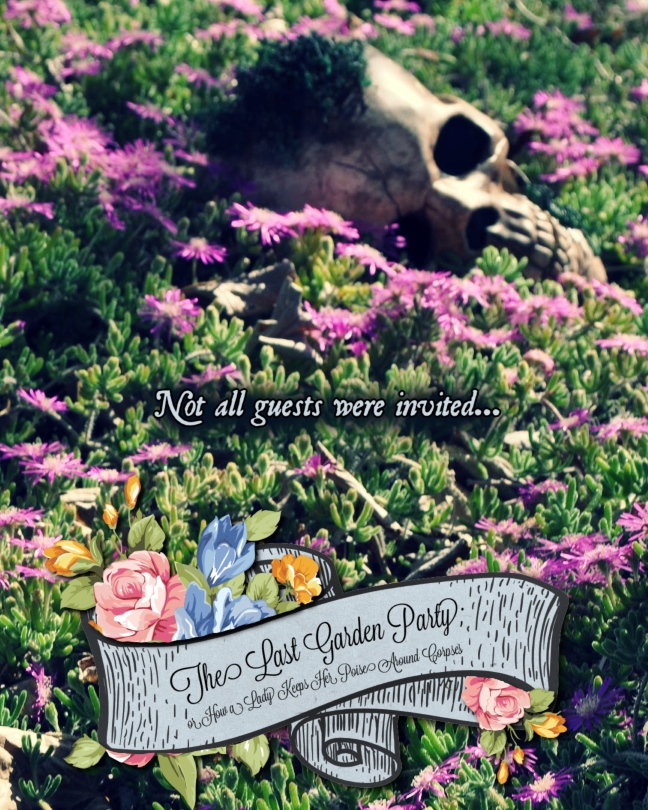
As Daniel said, this cast sparkles, but who plays these crown jewels of characters in our Victorian farce? Stay tuned, because we’re going to let the actors tell you their sides of the story in Upstairs (and Downstairs): The Making of The Last Garden Party (Part 2). And don’t forget your tickets! You can buy them here or at Red Rock Books now.
–Master Mystery Productions
 Master Mystery Productions