The Mad Hatter asks a very important question at teatime: “Why is a raven like a writing desk?” Without either, for instance, would we even remember Edgar Allan Poe? The writer and their desk (or notepad or laptop or word processing app on their phone) is the most powerful in the creation of new theatre. Without the words on the page, there wouldn’t be a Master Mystery Productions. We have always championed new and original works, and Malice in Wonderland continues the tradition of letting blossoming playwrights grow in their work. A returning writer and a debuting one join forces to turn a beloved childhood classic into our nest Master Mystery Production. Learn more from Janis Kunz and Devanne Fredette, our talented playwrights, about how they wrote Malice in Wonderland in this behind-the-scenes blog post.
WHY IS A RAVEN LIKE A WRITING DESK?: The Making of Malice in Wonderland (Part 2)
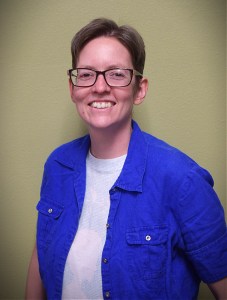
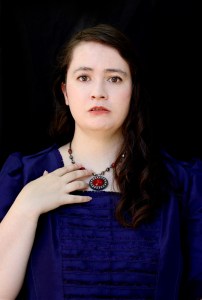
MMP: Welcome to the MMP blog, Janis and Devanne! As Hall of Fame Artists, you both have a ton of experience working on our productions over the years. Could you give us a brief recounting of your MMP careers, please?
Janis: I started with MMP in 2018 on my first-ever stage performance as Polly the Parrot in Mutiny on the Sea Witch. From there, I worked as either a member of the cast or tech crew on 16 more MMP shows, doing things from set work, costumes, props, more puppetry, voice-overs, and performing in multiple SoCal cities. The most recent production was this year’s Murder at the Red Fez revival where I enjoyed doing art and set dressing. I’ve been so blessed and honored to win awards for my work, and I’ve gotten to work alongside the incredibly talented Devanne for many of the shows!
Devanne: I’ve been a part of MMP since 2016, starting with The Last Garden Party. I think we all pride ourselves on the work we did together on the production. Starting from such a small production of around five people when it comes to the sets, we have a hand in just about everything from props to makeup to costumes and jewelry. However, as MMP has grown, our talents have gotten a bit more specialized. I myself have been working mostly within scenic art. My first show of this, I believe, was for the production, The Silent City, but has grown to “The Renaldo” in How to Solve a Murder and, more recently, a few foreshadowing tarot cards for the 2025 revival of Murder at the Red Fez. That’s just to name a few. It’s kind of awe-inspiring to look back at over 18 shows and try to remember what you have done and the awards and feats you have achieved. Regardless I think it’s gone beyond fun. Working with Janis for almost 16 of them has been a blessing and half. Janis is amazing and a wonderful partner. So, I don’t think I’m wrong when I say Malice in Wonderland is basically our natural progression and our ode to working together for so long.
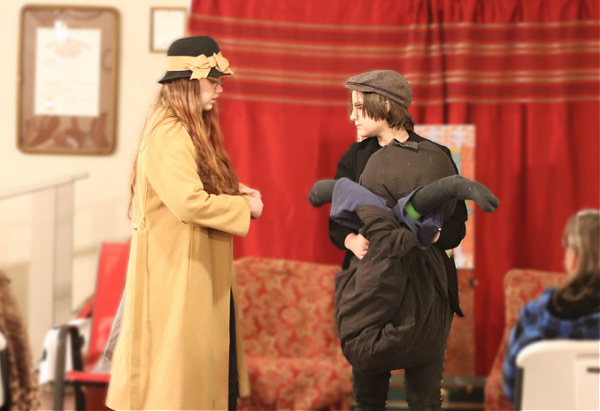
MMP: Janis, we’d like to start with you. In 2023, MMP had the pleasure of staging your first play, How to Solve a Murder. How does it feel getting a chance to hear your words—both this play and Malice in Wonderland—come to life through actors, costumes, and more?
Janis: Utterly amazing! I picture what I write very visually, and I also think about what kind of effect or reaction it will have on someone reading it. So with writing plays, I totally love getting that opportunity to see it in the flesh and to hear audience reactions. There’s just no match for hearing an audience roar with laughter at a comedic scene that was deliciously fun to write, like Brewster telling Reeves there’s a second dead body stashed in the trunk. Or watching actors add these perfect character touches to these fictional people that up to then I was only able to enjoy in the solitude of writing them, but now I get to share them with others in the coolest way possible! This happened over and over again on How to Solve a Murder, and I’m seeing it at the rehearsals of Malice now too. It’s fabulous! It really is my favorite thing, and I certainly plan to do more playwriting!
It’s funny though, because there’s also this point where it stops feeling like something I wrote, or co-wrote, and it takes on a new life as this collective creative project of all the actors and crew. I listen to it being performed, and I forget its origins as a jumble of ideas frantically typed at my computer. I’m just watching it like an audience member and relishing in the magic of the theatrical performance. I am really excited to share Malice with audiences!
MMP: And Devanne. You’ll be making your debut as a playwright for MMP with Malice in Wonderland. You were invited to write for us way back in 2019. Tell us a bit about the origins of the script.
Devanne: Malice In Wonderland began as a request from Ann Rizzardini, Red Rock Book’s very own owner, to write a play based on Alice in Wonderland. Red Rocks Books has been the home of many MMP shows so when I was asked to write a show for them, I was incredibly honored, and with a fairy tale, no less, that is as respected and loved as Alice in Wonderland, I also knew I had my work cut out for me. So, I started at the source. Personally, I started listening to the audiobook to be able to visualize what I could carve out for Malice. It was quite fun, and I would find out soon quite in theme. Malice in 2019 was quite fun writing; It was decided early on to be a more family-friendly show with the idea that it would have a sort of mini-carnival in the bookstore like painting-the-roses-red and just experimenting with different whodunits and whydunnits and all the other hullabaloos.
However, Malice was originally set to perform in 2020. All of us will recall that was the year of the lockdowns, and so Malice would be gently set down. During the year, I kind of found myself in writer’s block. There was just something missing and the thing about mysteries…you have to keep it a mystery. That is until Janis, Daniel, and I had grouped up to write a full script, now titled Heart and Soul: A Musical Journey. Working and writing together, especially in a genre I have not had much experience in, really helped push my writing in a good direction. And, of course, teaming up with amazingly multi-talented Janis Kunz really pushed Malice over the finish line, and I believe it’s exactly what Malice needed to come out strong.
MMP: Janis, why don’t you tell us about how you came aboard to take Malice over the finish line?
Janis: Well, I got to experience collaborating on a script when Daniel Stallings helped me work out plot kinks in How to Solve a Murder and bring it to producible completion. Devanne and I had many conversations about writing. She had told me about Malice being under construction, and I immediately wanted to work on it as a production. It sounded so cool. So I was eagerly waiting for its script to be finished. This was about five years ago. In that time, I got to work on another script writing project with both Daniel and Devanne, which was an awesome experience! We worked really well as a writing team! That project fell through for other reasons, and Daniel (who was to produce Malice) approached me about if I’d like to help Devanne complete the writing of Malice. He barely had the sentence out before I was jumping at the chance! I knew the direction of the script and absolutely wanted to collaborate with Devanne again, so it was a no-brainer. Over several tea parties–I mean, writing sessions–Devanne and I fleshed out the rest of what the script needed to become this fantastic collection of puns and character moments for everyone to enjoy!

MMP: Without mentioning spoilers, what were the parts of the original Alice’s Adventures in Wonderland by Lewis Carrol that inspired you both?
Janis: Majorly, it was the long-beloved characters. They are such madcap fun! And great fun to write as well! It’s a fanciful adventure with so much imagination. It’s easy to find inspiration in it and further these moments in our new story about Alice’s trial. So that was definitely a draw for me to want to work on this project, to try and recapture these characters and give them new lines to say. Another big thing for me is how Wonderland is allegorical to stuff in life. The things the characters do are crazy beyond doubt, but when you look closely you see parallels to what people do in real life and it makes you think. I enjoyed incorporating some of that into Malice too. Some backward thinking or heavy focus on the wrong questions and couching it in absurd situations and silly word play, like in Carrol’s original.
Devanne: I have to agree with Janis. These characters are beloved and absurd on the surface, but they are so much more. The thing about fairy tales, especially the more modern fairy tales, is that they often have a way of criticizing or portraying their world hidden behind allegories and word play. Alice In Wonderland is a masterclass in such writing. The story is so versatile, and I found myself inspired and incredibly ecstatic at writing a script that pulled out so much of the fun that I found from the story.
MMP: There’s also heavy inspiration from Through the Looking Glass. What was it like balancing those two stories and sets of characters? How did you decide what made the cut?
Devanne: That’s the fun thing of Through the Looking Glass. It’s only a continuation of the silliness of Alice in Wonderland albeit “mirrored.” The difference in the stories is more of the setting in which Alice travels through in Wonderland. We found that sticking to more of the Alice in Wonderland characters to be the better choice as they are incredibly beloved characters made popular by the animated movie and other such mediums. However, just like Tweedledee and Tweedledum belonging to the Through the Looking Glass novel, bringing in the big characters like the Red Queen and the White Queen was almost natural as the story needed such characters.
Janis: I didn’t have much trouble balancing them, per se. I’m more likely to confuse which book a particular character or occurrence comes from! We did intentionally draw from both though and try not to leave the most recognizable things out. We chose things that would best support the story we were trying to tell, and when we could include cameos we did, such as the gnat from Looking Glass that had both Devanne and me giggling when we read the book together during our research sessions.
MMP: What was the biggest challenge facing the script?
Devanne: For me, it was balancing the absurdity to the mystery. See, if it’s so absurd, then the solution of said mystery is near unobtainable, leaving the story unsatisfying.
Janis: For me, it was getting the details to match up, have the thread of the mystery throughout, and not give too much away but also have enough so the solution is satisfying and deducible.

MMP: This script contains three queen characters (not counting our Almost Queen, Alice). How did you balance, tonally and through dialogue, those three similar attributes, particularly since the Red Queen and the Queen of Hearts are so often interchanged in other Alice media?
Janis: I have both a bad memory and face blindness and am notorious for confusing characters in movies, etc. So, I intentionally try to create distinctions. When writing my first play, I reread each character’s dialogue and considered if it was distinct and if it sounded specific to them. Are they drawing from an individual’s vocabulary? Are they someone who uses a lot of alliteration? Do they use curt sentences or long ones? I did the same with the queens. I would look back specifically at their dialogue and actions and consider if it matched them. Does the queen support Alice or not; Does their line incorporate that stance? Are they focused on refinement, and is that reflected in their word choice? Are they easily flustered and speak without editing their words?
Red Queen is short-tempered and petulant to losing, so her vocabulary and blocking supports those traits. The Queen of Hearts is similar in some regards, but her force comes from being in command and having a “point A to point B” personality. The Red Queen would say “off with their head” in anger, but the Queen of Hearts says it, because she wants things taken care of quickly and efficiently. However, I do have to admit it was a challenge to not get confused during the writing process and even now sometimes I’ll say the wrong character name during rehearsals!
Devanne: I think what helps keep them separated from each other is visualizing each of the characters in their perspective game. See, Alice in Wonderland and Through the Looking Glass characters, when it comes to royalty, are primarily based on the games of cards and chess. Characters like the Queen of Hearts is actually a caricature of Queen Victoria visually; however, it is often used to critique royal systems and accepted death sentences via guillotine. While Red Queen who is usually used interchangeably with the Queen of Hearts–probably due to the red hearts–is a lot stricter. Holding rules to the highest degree is often a critique on Victorian society. Now attach each of the symbolism to each of the characters as a Queen of Cards and Queen of Chess and you have two very different characters. One a caricature and one the utmost strictest character. And in Wonderland, the absurd is most accepted.
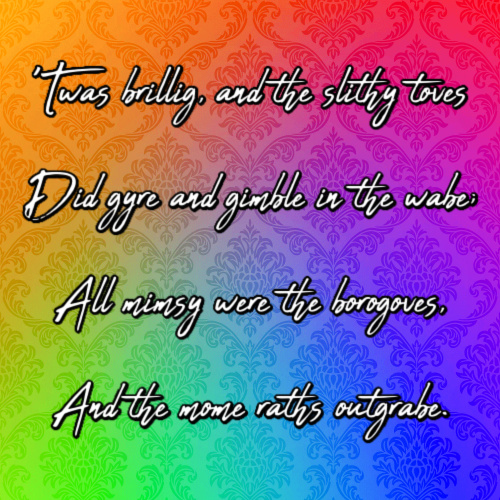
MMP: One thing that was particularly notable about your script was the great sense of word play that was sympathetic to the original story. Lewis Carroll’s Wonderland was filled with poems, songs, nursery rhymes, stories-within-stories, and puns. How did you incorporate those elements into the show? Which was the most fun?
Devanne: I think incorporating all the word play was just a natural casualty of reading Alice in Wonderland. The story is a play on words itself and the chaos and the fun that is English and its grammar. I think picking and attaching different types of word play to all of the characters was fun, and, when it’s read out loud, it just has that spark that is both silly, inviting, and wild.
We have puns and alliteration with Hatter and Hare, riddles and metaphors with Cheshire, hyperbole with the Queens, questions with Caterpillar, rhyming with Dormouse individually. However, when they all come together, these character traits blend and twist in the best ways, creating this both big and exaggerated plot with subtle details and symbolism of their story of why they’re here and their own stories and how they likely will continue going forward. It isn’t until Alice comes in that we see the contrast of seemingly absent word play, showing the audience what “normal” is. However, we shouldn’t forget Alice’s Adventures in Wonderland that little ‘madness’ is just as subtle as she is. I think overall that’s what I enjoy most of the process.
Janis: The puns! I love puns and using wordplay, so it was so much fun to just fill each page with everything I could think of! Devanne and I put in so many; I think there may even be some that not everyone will notice. She and I were cracking each other up while writing it. And I think that helps because if you are enjoying something, then that translates to the finished product. I loved the opportunity to go wild, be inspired by the original, and have a chance to add things like poems and stories-within-stories–you don’t always have that in a project. I kept putting in rhymes, in-jokes, silly tongue twisters, and puns galore, because I knew it would tickle Devanne. It was what she was excited about and sold me on when we first discussed the script, so I had this bar to aim for; I wanted to do justice to what had already been written when I joined. I wanted to be a playwright who did right by the play!

MMP: Which character was the easiest to write, and which was the most difficult for each of you?
Devanne: I think I enjoyed writing Cheshire the most. Their testimony was the first I had finished. They brought out a bit of mischievousness I have towards the script. However, I think the easiest to write was “Teatime,” being both Hatter and Hare. I think this was because Hatter and Hare have this sort of constant dialogue, never one without the other, and I think it reflects that ease and that trust I have with Janis and Daniel that we can play off of each other and the characters just come out better for it.
Alice was probably the hardest to write for. I want to say mostly because she is the titular character and an icon. There are expectations of who she is and who she needs to be. My original impression of Alice was that she was this scared little girl trying to get back home…and perhaps that’s still a little true. Or perhaps it was reading how Lewis Carroll interpreted Alice, but Alice is the origin of all of the word play, of all of the creativity, of the world, of the characters themselves, and she delivers it to the reader very smartly and with such sass that feels natural for a child in their head to do. So, with that in mind, she became a bit easier to write for. With a bit of research into British mannerisms and checking back and forth with Janis, we settled on her character traits, and I couldn’t be happier with our interpretation of our Almost Queen, Alice.
Janis: Hatter was the most fun. I love his madness and eternal existence of leisure activities. I enjoyed giving him some moments of almost being helpful! White Rabbit was the easiest to write because of his pivotal role in the plot and his clear-cut personality and desires. Writing his nervousness and dreaminess about food flowed easily.
The hardest to write was Alice. I remember Devanne was hesitant about knowing how to make her sound like a young British girl, so I offered to write Alice’s testimony monologue for her. I think it was the pressure of Alice being the main character and the one who the audience has to make their verdict about. Also, she isn’t as large of a personality as the Wonderland inhabitants, and subtle is harder to write than flamboyant. But I like how it came out and seeing the depth that the actors are giving her lines in the rehearsals solidifies it for me!
MMP: What do you think is key in translating Wonderland to the stage, especially a stage as unusual as a bookstore like Red Rock Books?
Janis: Imagination. The tech director and tech heads are pulling out all the stops when designing it to feel immersive and creative like stepping into a book. That is definitely key. Also, Devanne’s directing is shaping it into something big and bold, which Wonderland needs. If the actors believe in their character, then the audience will too and enjoy seeing the antics play out. And the antics abound! You can’t take something like this serious and subtle, it needs to be larger than life and transport you into another world.
Devanne: Imagination and collaborative effort to have and find fun. There’s almost something freeing seeing people come together and have fun and be so expressive and with such passion. I wholeheartedly believe that to encourage that in all aspects from cast and crew and guide it past your expectations is probably the purest form of a joy I as director and co-playwright can ever have.
Malice in Wonderland from day one has been an ensemble piece both in writing and in performing, and I think it truly flourishes when everyone comes together with such trust, passion, and love that we have for each other and for Wonderland.
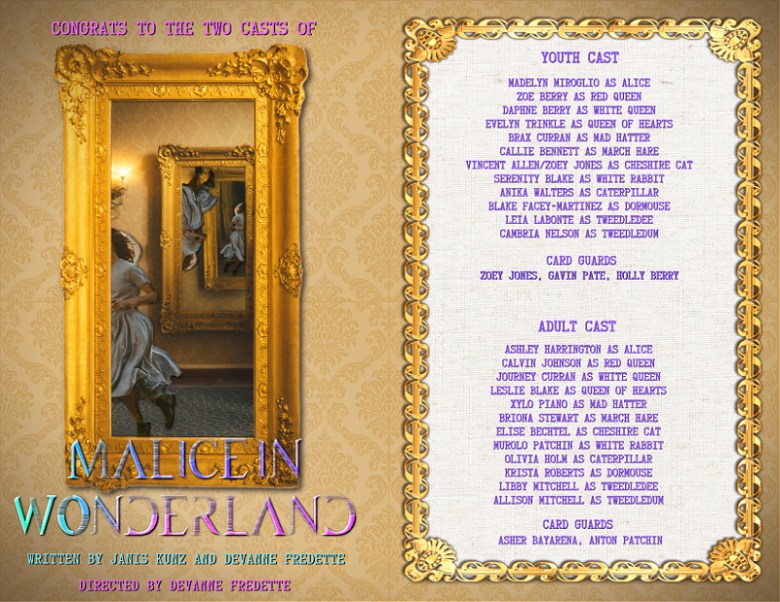
MMP: After auditions and the staggering turnout we had, there were questions about inserting new characters into the show. How did you go about doing this?
Janis: During the writing stage, there were characters we talked about including, but we didn’t want more parts than we got actors, so they were kept on the back burner. As auditions approached, there was huge interest, so then we knew we might need some of those extra parts and worked out how they could be added, if needed. Like inserting a prologue and intermission poem or adding in Caterpillar as an extra testimony that didn’t affect the plot. And wonderfully, we had so many auditions that they were needed!
Devanne: When we started, we had begun working on our list of characters. There was a discussion on the importance of each character and the best way we could portray them. Malice already had asked for a large cast. With there being a lot of roles, I had half-expected the need to double up on parts, but that’s also the hard part with these big and iconic characters. However, on the other side, there was this desire to see more of these characters on the stage, especially Caterpillar, but the problem again was would we have enough people to portray them.
After the script was first finalized, we started talking about all the ways, if needed, to change the script and the differing dynamics that would bring, and the amazingly spectacular Janis Kunz had written Caterpillar and placed them into script expertly that it almost feels unnatural now to not have them.
Now when we arrived at auditions and with the abundance of actors, it was a quick decision of these actors to have an amazing audition. You deserve a role. We just need to make you one. My request was to try and pull in more of Through the Looking Glass characters, and we had then decided on Tweedledee and Dum, made popular by the cartoon but originating from Through the Looking Glass. The only problem then would be “Where would we put them?” as pushing them into the story now could mean plot holes and a different dynamic. However, taking what we know from the books and the cartoon, storytellers are telling a story within a story. As we were casting, Janis wrote them into the script as a frame device, and to add more cherry on the cake, Daniel wrote this poetic short story. In doing so, I think it adds that much more detail that I can’t envision how it would be without it anymore.

MMP: We know it must be impossible to choose, but do you each have a favorite part of the play?
Devanne: Oh boy, that’s a tough one, but I think the feeling that has left me most satisfied is the Finale. It’s been a wild tale the past 6 years but also a testament in the story itself. A story deserves an ending. So many don’t get to see the light of day, and the ending has changed over the course of its production. It leaves me with such satisfaction that the solution couldn’t be any other way, and I am happy with it.
Janis: Yeah, it’s so hard to pick a favorite, but I do so love the group scenes where there is chaos and the characters/actors are reacting to each other. They are challenging to write with so many moving parts, but they are so fun to have taken place!
MMP: What do you hope audiences will take away from the show itself?
Janis: I hope their sides are sore from laughing and their hearts are warmed with good story moments! I hope they are entertained and fulfilled by invigorating word play. I also hope they are inspired by the classic and new elements and come away just a little curiouser and curiouser to partake in six simple pleasures before breakfast. 🙂
Devanne: To purely have fun. It’s silly. It’s wild. It’s big. It has so much meaning. It is a short tale but with big intentions meant to invoke that childhood wonder, creativity, and if nothing else just a hint of mischievousness.
MMP: Thank you so much, ladies, for your answers, and congratulations again for your new play. We are excited to see the final product in person!

A new playwright isn’t the only thing we’re debuting with Malice in Wonderland. And a new queen gets crowned as well. Hall of Fame Artist Devanne Fredette makes her debut as a director with this production, and we had the pleasure to interview her for the blog. Learn more about Devanne’s dreams as a director for the show in our next blog post, The Queen of Arts: The Making of Malice in Wonderland (Part 3).
–Master Mystery Productions
 Master Mystery Productions