
Psst. What’s the password? You ain’t gettin’ into a juice joint like this without one. Capisce? Before you panic and try to drum up as many words as you can from your flapper lexicon, we’ll let you in for a sneak peek at how we dreamed up the illustrious (and ill-fated) Red Fez speakeasy. Turning a music store into a underground nightclub from the Jazz Age takes a little extra work, but with the help of amazing, talented artists, designers, and dressers, we were able to inject the right amount of jazzy flair into Moe’s Music for a night a mystery, murder, and mayhem. Set Designer Daniel Stallings will guide us through a tour of the dreams, designs, and more behind the Red Fez.
WHAT’S THE PASSWORD?: The Making of Murder at the Red Fez (Part Three)

When I first wrote and performed Murder at the Red Fez in 2013, there was no set. I performed in living rooms and once on Zoom. So the Red Fez was nothing more than an idea, an atmosphere, a mindset. So when the ten year anniversary was coming up and it was time to decide on a show, I thought about reimagning the Red Fez as an actual space. What would look like in my head?
The first inspiration for the speakeasy was its name. The name was an homage to the clients who booked its first iteration: The Red Hat Ladies of Bakersfield. In the 1920’s, exoticism was a major aesthetic movement for decoration, which led to the name choice. Now when you approach set design, first think of who owns the space. In this case, it was a ganster named Mickey the Muckler. Dangerous, devious, successful. This was a world of underground wealth. Diamonds smuggled under dark. He is a man who appreciated the finer things in life. He loves beauty, luxury, the dark, the exotic, the mysterious, the unusual. I started to view Mickey as a world traveler as well, a collector whose pieces were gathered through more illicit means.
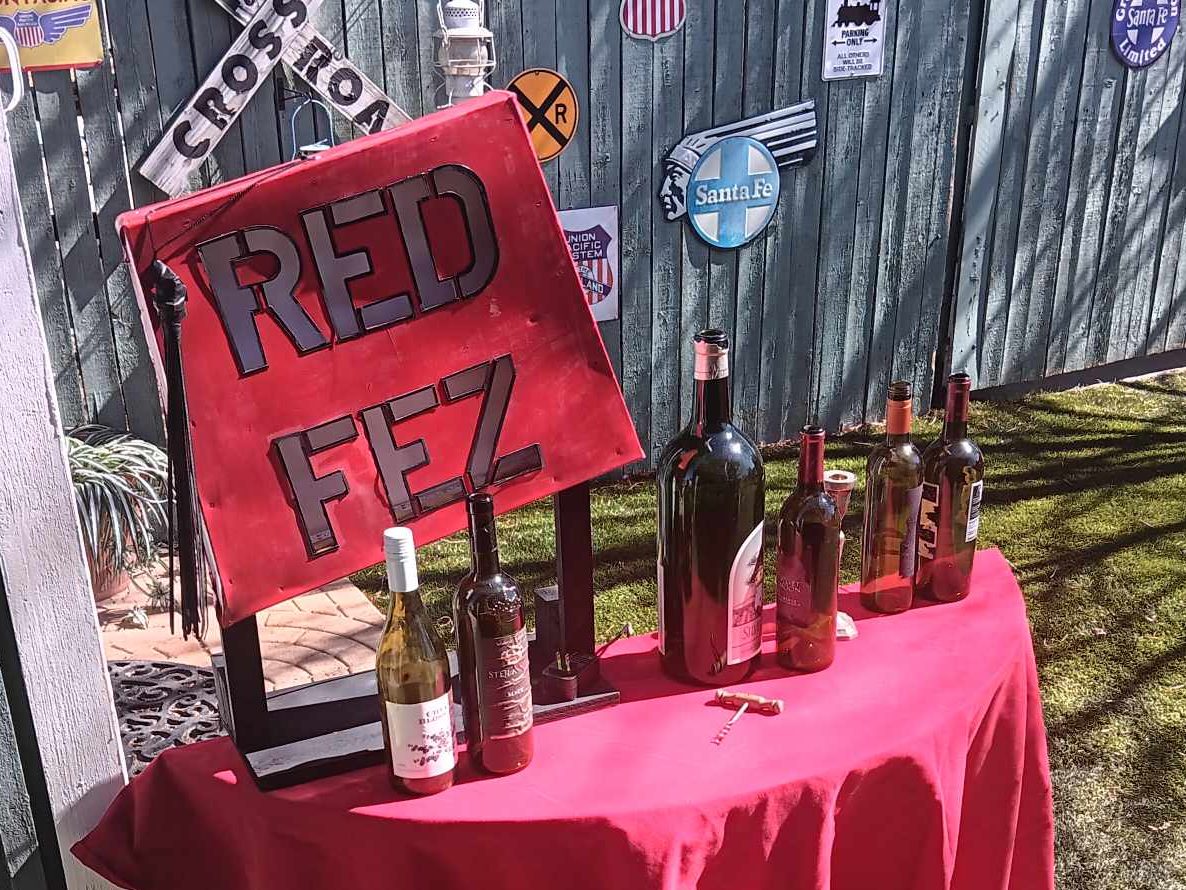
Elise Bechtel, acting as Lead Set Dresser for the production, started with a general compiling of inspirational imagery on a Pinterest board. She was given a simple prompt–Roaring Twenties speakeasy in the colors of red, black, and silver–and set to work finding images to serve as jumping off points. Red was an obvious color choice for Murder at the Red Fez, but black and silver defies the expected Art Deco combo of black and gold by introducing a cooler, frostier metal to highlight the razor-edge of danger in the club. Photographs of shadowy spaces lit with red lamps on cocktail tables, sectioned-off booths, art draped in half-light began to appear. A good starting line. We started extrapolating ideas from there, including memories of my recent trip to Broadway to watch Cabaret at the Kit Kat Club, to create the immersive environment. An old VCR game called Clue II: Murder in Disguise provided even more bonkers inspirations for set design as the characters travel the globe to far-flung domains. Eventually, I built this concept in my head of an explorer’s club–like Disney’s The Jungle Cruise ride meets a 1920’s nightclub. A place where Mickey the Muckler returned from his travels with new art and artifacts acquired through suspicious means. These pieces he would display among greenery and hidden in little pockets around his speakeasy like a dragon with his hoard. It adds a sense of curation to the place. A sense of history. And a sense that things aren’t quite kosher within the walls of the Red Fez. A home for dark, underground secrets. Warm, patterned rugs will add spice to the floor. Mirrorballs will twinkle. The audience will be nestled in simulated “booths” where the actors can sit and gossip and throw shade and spill secrets directly to the guests in an intimate environment.

Lighting provides one of the key atmospheric layers to the design of the Red Fez. We’re swapping overhead fluorescence for mood lighting. Veteran lighting designer Angie Sonia-Pritchard collaborated with Elise Bechtel and Janis Kunz to design a series of small table lamps operated by remote control to look like fez hats. Using tap lights, balloon holders, perfume bottles, and bowls, gorgeous lamps materialized and will add the right amount of sexy lighting to the speakeasy. They also designed a series of silver clamshell footlights for the stage at Moe’s Music. Keeping the lights low allows for the right atmosphere to develop, one of suspicion, intrigue, and imminent danger.



A motif I saw repeated throughout the deliciously immersive scenic design at Cabaret at the Kit Kat Club was eyes. Thousands of eyes watching you from every corner of the reimagined theater. And befitting a show about a gangster thief, I’ve boldly…borrowed that motif for Murder at the Red Fez. This created the atmosphere of constant surveillance in the speakeasy, which is echoed in the story as well. Throughout the set, the artists snuck in lots of artistic eyes to watch over the guests. Some are abstract, others literal. There are portraits where the subject stares directly into you. And as a nod to our original clients, many of the portraits will boast stunning red headwear.
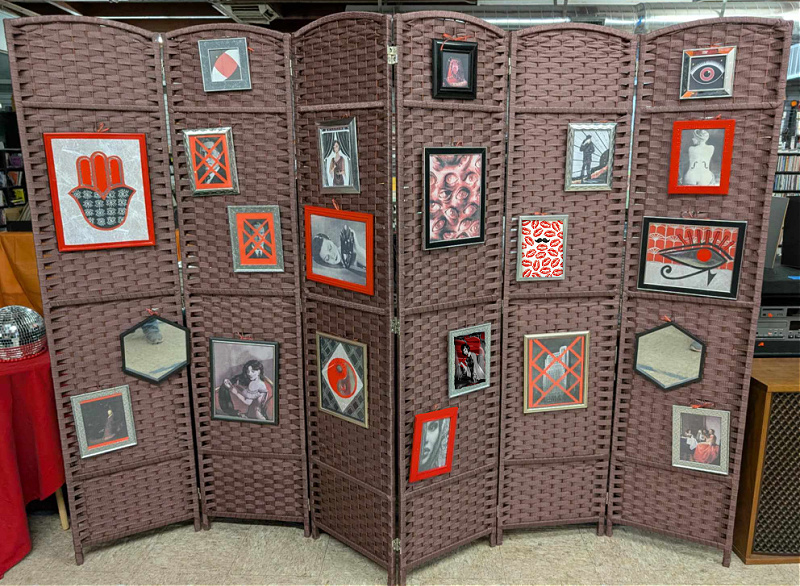
Mickey is a collector. He surrounds himself with beautiful things and beautiful people. So we wanted the audience to fill that way–surrounded by Mickey’s art. That meant sourcing and making A LOT of art for the show. One way to create to display was the design of an art wall. We had a large woven screen donated by Elise Bechtel for the show. On this screen, we hung examples of art all tinted in reds, blacks, and silvers. The art hugs you, looks over your shoulder, watches you carefully.

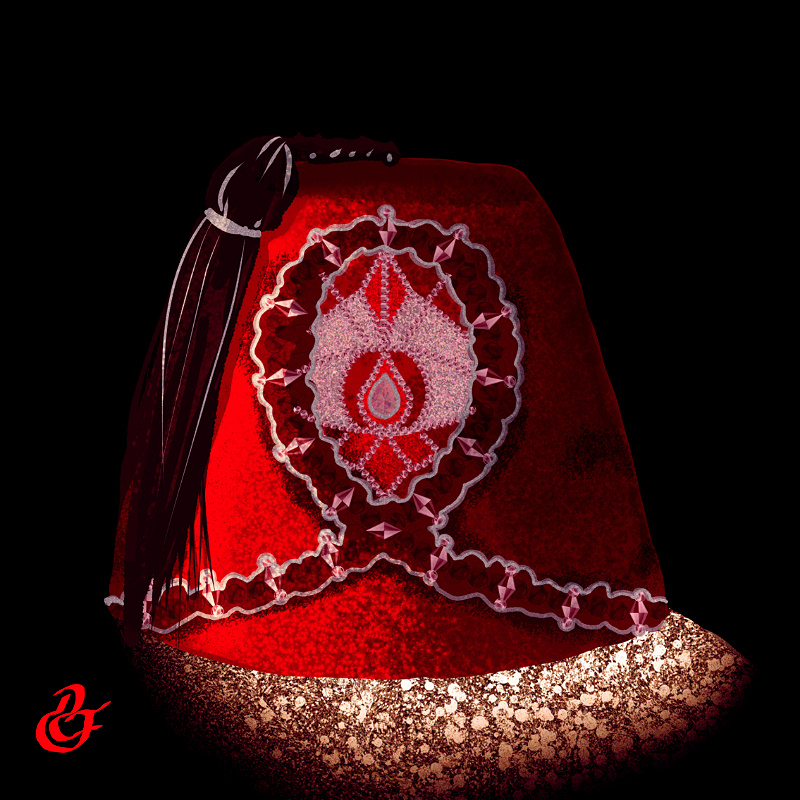
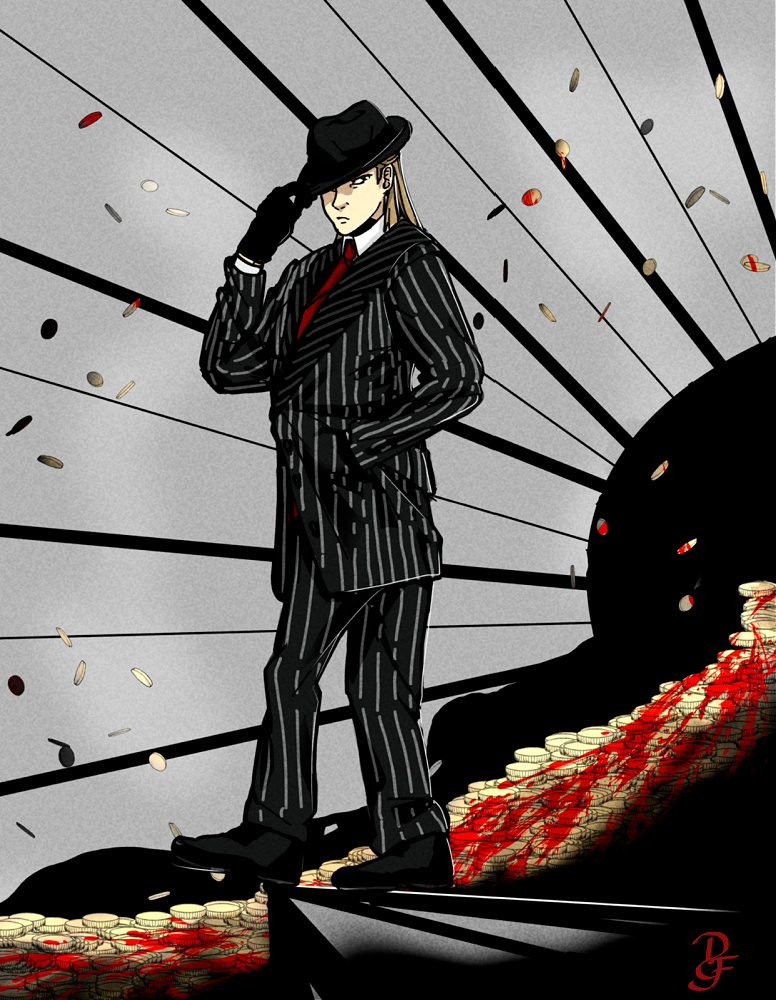
Original artwork by Devanne Fredette, created for the production. Artist reserves all rights.
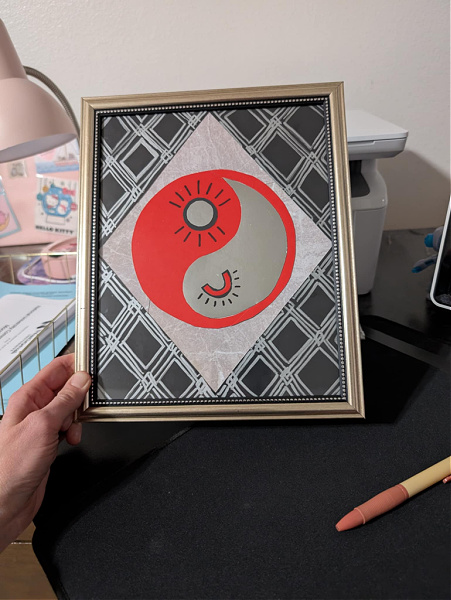
A lot of art was created by members of the production. MMP Hall of Fame Artists Devanne Fredette and Janis Kunz made large creative contributions to this production with additional work by Murolo Patchin, Elaine Stewart, Elise Bechtel, and myself. I really just let them explore whatever they wanted. They had a grasp on the color scheme and the motif of eyes and went to work. Devanne was inspired by Tarot for some of her works featuring images of Diamond LaPore, Patrick O’Rourke, and Millie Carraway. Janis took inspiration from different cultures to represent the “eye” in art–such as an Ancient Egyptian Eye of Horus, and Egyptology was enormously popular in the 20’s–as well as stunning collages that echo the work of surrealists. We also included artworks that serve as clues to the story…if you keep your eyes peeled.

Samples of artworks by Janis Kunz. Artist reserves all rights.

Not only that, but we snuck in some Easter eggs from past Master Mystery Productions around the set. For example, the above picture shows a “Renaldo” painting–created by Devanne Fredette–as a prop for Janis Kunz’s play How to Solve a Murder, also set in the 1920’s. As a fun wink-wink nudge-nudge to our performances past, especially as this is our tenth anniversary production, we included it in our speakeasy. We’ll also have references on set to other 20’s-themed shows from MMP such as Bury Me in Paris and Tete-a-Tete. How many can you spot?

All combined, the Red Fez will be the perfect stage for our scintillating suspects to spill their secrets. The designs are rich, intense, and evocative. With our actors dressed in their best glad rags in shades that harmonize with their environment, Murder at the Red Fez will echo the underground sparkle of a Jazz Age speakeasy. And don’t forget the signature drink we’ll serve. Don’t you want a taste of what MMP has to offer this year?
Murder at the Red Fez opens in less than a week! Tickets are available at Red Rock Books.
See you at opening night!
–Master Mystery Productions
 Master Mystery Productions